Marketing Trends 2026: What's Actually Changing (And What You Should Do About It)

By Satyam Vivek | December 10, 2025 | 14 min read

Marketing Trends 2026: Data-driven analysis of 5 structural shifts transforming marketing. Learn about AI co-pilots, Answer Engine Optimization, privacy-first measurement, commerce media, and why creative is now your competitive moat.

Most "marketing trends 2026" lists are just a pile of buzzwords: AI, metaverse, NFTs, AR, something-something Gen Z. Useful for clicks, not for planning.

This piece is the opposite: it's built from hard data, platform moves and adoption signals, not vibes. The underlying research looks at global ad spend (now >$1T, ~73% digital), retail media and CTV growth, AI adoption in marketing teams, privacy/regulation, and creative effectiveness studies across the last few years.

If you're a marketer planning 2026, the question isn't "What's new?" It's: "What's structurally different enough that my current playbook breaks?"

1. The 5 Structural Shifts Behind Marketing Trends 2026

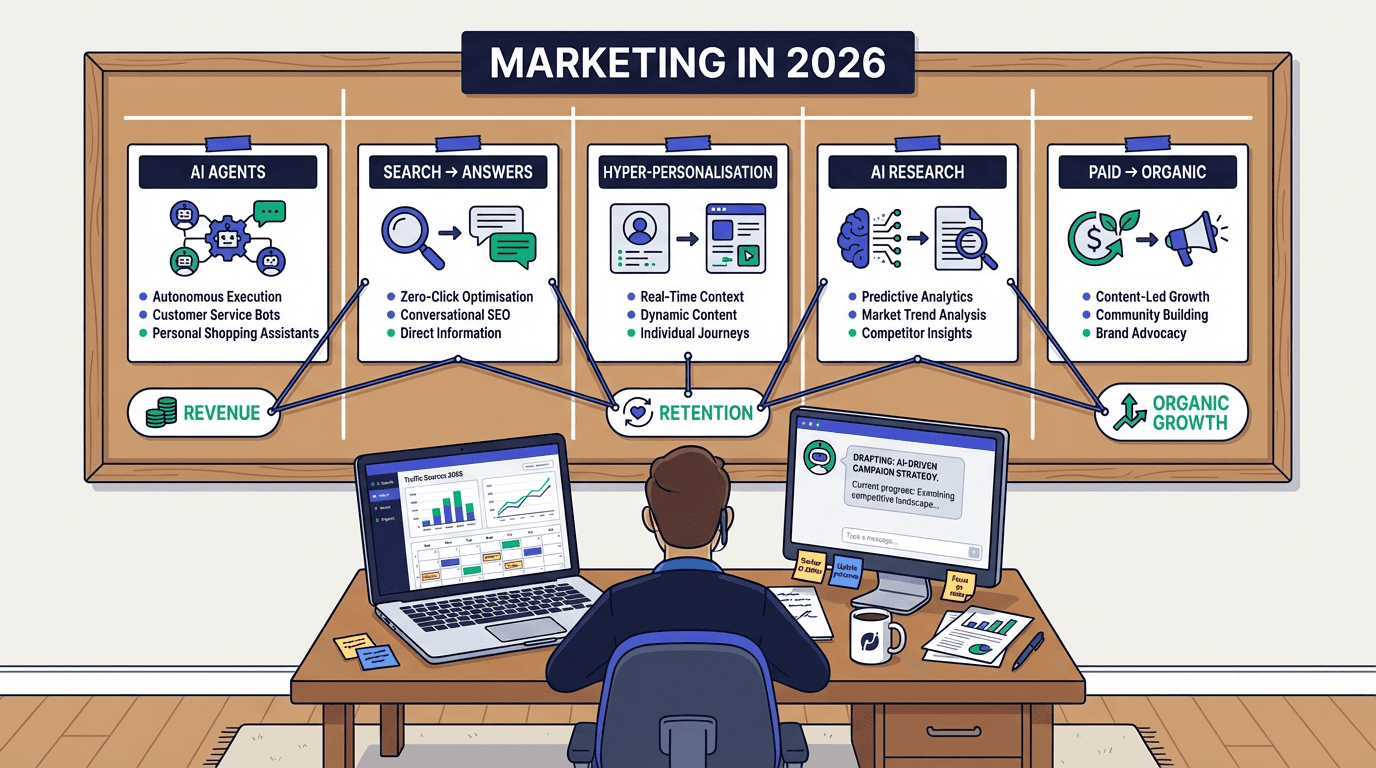
Forget individual channels for a second. At system level, 2026 marketing is defined by five major structural shifts:

Shift 1: AI as Co-Pilot, Not Toy

| Dimension | Old World (2015–2021) | New World (2024–2026) | |-----------|----------------------|----------------------| | AI Role | Experimental side project, occasional copy help | 65% of companies use gen-AI in at least one function | | Adoption | Early adopters only | 68% of marketers use AI in daily tasks | | Impact | Novelty | 82% report productivity gains (35% "significant") | What breaks if you ignore it: You keep manually doing what competitors now execute faster, cheaper and 24/7 with AI "operators."

Shift 2: Search → Answer Engines

| Dimension | Old World | New World | |-----------|-----------|-----------| | SEO Goal | Rank 10 blue links, measure clicks | Conversational AI "snapshots" dominate | | User Behavior | Click through to websites | Zero-click answers grow; 20–30% CTR drop on AI-answered queries | | Budget Impact | Open-web display dominant | Forrester expects ~30% cut in open-web display as AI answers eat clicks | What breaks if you ignore it: Your organic strategy is built for a SERP that users no longer see.

Shift 3: Privacy-First, Model-Based Measurement

| Dimension | Old World | New World | |-----------|-----------|-----------| | Tracking | Third-party cookies, user-level attribution | Chrome finishes 3P cookie phase-out | | Data Priority | Third-party audiences | 80% of marketers prioritise 1P data | | Measurement | MTA dashboards | 49% already use MMM; 56% plan to increase MMM use | What breaks if you ignore it: Your performance numbers stop matching reality; budget debates turn political instead of data-driven.

Shift 4: Media → Commerce, CTV & Walled Gardens

| Dimension | Old World | New World | |-----------|-----------|-----------| | Channel Mix | Search + social + TV as separate buckets | Retail media heads toward ~$175B (~16% of global ad spend) | | Video | Linear TV dominates | CTV ad spend climbs ~15–20% YoY while linear TV shrinks | | Commerce | Separate from media | Social commerce in the US crosses $100B by 2026 | What breaks if you ignore it: You plan channels in isolation and under-weight the places where discovery and purchase are now fused.

Shift 5: Creative & Brand as the Real Moat

| Dimension | Old World | New World | |-----------|-----------|-----------| | Competitive Edge | Media advantages, targeting tricks, bidding hacks | ~50–70% of sales lift comes from creative quality | | Content Production | Manual, slow | 44% of marketers already use AI in content production | | Brand vs Performance | Separate teams, separate budgets | "Brand as performance" campaigns deliver 4–5× higher conversion lift vs pure DR | What breaks if you ignore it: You optimise bids and audiences while losing the only lever that still compounds: distinctive, high-performing creative tied to a real brand.

---

2. Trend Deep Dives (With Early Signals, Not Hype)

Trend 1: Generative AI Co-Pilots in the Marketing Stack

What's actually happening:

Adoption is already mainstream, not speculative:

  • 65% of companies use generative AI in at least one business function (up from ~33% a year earlier)
  • 68% of marketers use AI in their daily tasks – mostly for content, analysis, and basic optimization
  • Productivity impact is real but not yet "10×":

  • 82% say AI improved productivity
  • But only ~35% call the lift "significant"
  • Early ROI is incremental, not magical
  • Use cases cluster into:
  • Content & creative: copy, images, video scripts, variations
  • Media & bidding: PMax, Advantage+ and similar black-box optimizers
  • Insights: summarising dashboards, predicting outcomes, explaining anomalies
  • How this changes your job in 2026:

    Your edge is no longer "we use AI"; it's:

  • Where you let AI operate autonomously
  • How you wire AI into your data and decision loops
  • Which guardrails you set so you don't blow up brand or budget
  • Teams that win treat AI tools as junior operators, not content toys:

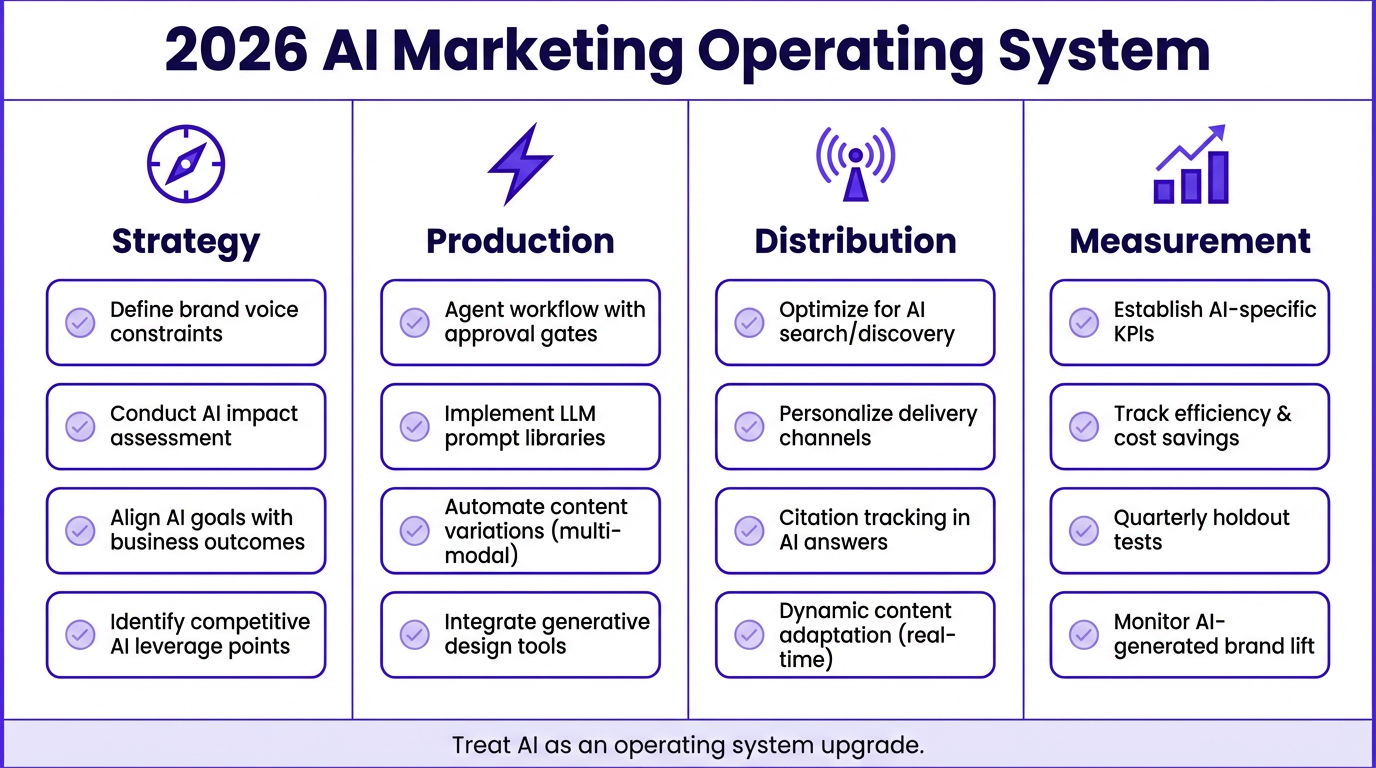
    AI drafts → humans refine → AI runs tests → models feed back learnings → humans update strategy Practical AI Readiness Matrix: | Area | Minimal 2026 Readiness | Good 2026 Readiness | Overkill (for now) | |------|----------------------|--------------------|--------------------| | Content | AI helps with first drafts only | AI + templates integrated into CMS + creative testing workflow | Full synthetic brand voice with no human oversight | | Media | Manual structure + platform automation | AI "co-pilot" suggests budgets/structures; humans approve | Fully autonomous "hands-off" media buying without strict guardrails | | Analytics | BI dashboards only | AI assistant that can answer "why did ROAS drop yesterday?" | Custom in-house LLM stack without clear use-cases |

    The real trend is operationalisation, not experimentation. 2026 separates teams that play with AI from teams that run parts of their marketing stack through AI.

    ---

    Trend 2: Search Becomes Answer – Rise of AEO (Answer Engine Optimization)

    What's actually happening:

    Google, Bing and others have rolled out AI answers on top of search:

  • Early experiments suggest a 20–30% drop in organic CTR when rich AI answers appear
  • Forrester predicts leading advertisers will cut open-web display by ~30% as AI answers and walled gardens steal attention
  • Users increasingly treat search as a conversation, not a one-shot query:

  • Follow-up questions, multimodal prompts (image + text)
  • "Explain this like…" patterns become common
  • New answer engines (Perplexity, Claude's search, ChatGPT with browsing, vertical AI search inside Reddit, StackOverflow, etc.) further fragment discovery.

    SEO vs AEO Playbook Comparison: | Dimension | Old SEO Playbook | 2026 AEO Playbook | |-----------|-----------------|-------------------| | Objective | Rank #1 for keyword | Be the most trusted explainer or product source for a topic/entity | | Content | 800–1200 word articles targeting a term | Dossiers, FAQs, how-tos, comparison tables, structured answers that an AI can compress confidently | | Data | Basic on-page SEO + a bit of schema | Rich schema, product feeds, FAQs, pricing, specs, reviews, all machine-readable | | KPI | Sessions, CTR | Presence in AI answers, assisted conversions, branded search lift, retention | The mental shift: Treat each answer engine like a new "user" that needs to be educated and fed. You're optimising for its confidence, not just human clicks.

    ---

    Trend 3: Privacy-First Data & Model-Based Measurement

    What's actually happening:
  • Chrome finishes deprecating third-party cookies for 100% of users; Safari/Firefox already block them
  • ~80% of marketers cite first-party data as their top asset for cookieless marketing
  • ~90% of B2C CMOs say they use data clean rooms for marketing use-cases
  • ~49% of marketers already use MMM; 56% of US ad buyers plan to increase MMM use
  • Shifting ~30% of spend to 1P-data campaigns can deliver ~2.9× ROAS in some setups
  • Old vs New Measurement Approach: | Question | If you stay in 2019 | If you adapt to 2026 | |----------|--------------------|--------------------| | "What drove last month's revenue?" | "Facebook says 55%. Google says 70%. Email says 40%. Nobody agrees." | "MMM + experiments show ~X% from paid social, Y% from search, Z% from brand/organic. We optimise at portfolio level." | | "How do we target?" | Third-party audiences, retargeting everyone | Logged-in, consented 1P audiences; retailer audiences; contextual; lookalikes from 1P; sandbox APIs | | "Where do we invest in infra?" | More point tools | CDP/CRM, clean-room access, MMM stack, consent UX, data governance | What you need:
  • A minimum viable 1P data spine (what do you collect, where, how clean is it?)
  • A measurement stack that combines: platform-side signal, experiments (geo / holdout / A/B), and at least lightweight MMM
  • ---

    Trend 4: Commerce Media, CTV, Social Commerce & Creator Ecosystems

    This is where most budgets actually move.

    Key Market Signals: | Channel | 2026 Projection | Growth Rate | |---------|-----------------|-------------| | Retail Media | ~$175B (16% of global ad spend) | ~13–14% YoY vs ~7% for overall ad market | | CTV/Streaming | >25% of TV ad spend | ~15–20% YoY while linear TV shrinks | | US Social Commerce | >$100B | TikTok Shop alone generates tens of billions in global GMV | | Influencer Marketing | 67% of marketers increasing spend | Micro-influencers deliver 2–3× engagement vs mega-influencers | Channel Strategy Matrix for 2026: | Surface | What's Getting Harder | What's Getting Easier | 2026 Bet if You're Rational | |---------|----------------------|----------------------|----------------------------| | Open-web display | Cheap, broad reach with solid tracking | Almost nothing – AI answers + privacy hurt it | Use sparingly for very specific contexts; don't build strategy on it | | Google search (non-retail) | Capturing generic info queries; SERP clutter | Capturing high-intent, branded and bottom-funnel queries | Maintain strong performance foundation; shift some top-funnel discovery elsewhere | | Retail media | Standing out without paying a tax; CPC inflation | Closed-loop attribution, product-level insights | Treat as joint sales + marketing lever; plan with trade teams and MMM | | Social (TikTok, Reels, Shorts) | Producing native creative at scale; signal loss | Attention, discovery, creator collabs, retargeting | Build creator + UGC systems, not just ad accounts | | CTV | Cross-platform measurement; fraud risk | Reaching cord-cutters with TV-like storytelling | Use for brand-performance hybrids with clear MMM/experiments | | Email / owned | List growth; inbox competition | Cheap incremental reach with 1P data | Make 1P email/WhatsApp push part of every campaign, not an afterthought | The winners in 2026 don't "add retail media and CTV." They rebalance the entire marketing mix around where discovery and purchase now actually happen.

    ---

    Trend 5: AI-Powered Creative & Brand-Performance Convergence

    Key Facts:
  • Creative consistently drives ~50–70% of sales lift in many attribution studies
  • 44% of marketers already use AI in content production
  • 76% have had AI-generated content rank at least once in SEO
  • "Brand as performance" work can deliver 4–5× higher conversion lift vs pure DR campaigns
  • Consumers are far more influenced by relatable creator-style content than celebrity endorsements
  • What's changing:
  • Volume is trivial; quality is scarce. AI can give you 100 variants; it cannot give you your positioning or story. Those still have to be designed.
  • Brand vs performance is collapsing. TikTok, Reels and CTV reward creative that does both: builds memory, codes, emotion AND gives a concrete reason/CTA to act now.
  • Creative is becoming a system, not a file. Continuous testing, element-level analysis (hooks, angles, visuals), dynamic creative that adapts by segment/context.
  • A Simple 2026 Creative System: | Layer | Question | Example Output | |-------|----------|----------------| | Platform idea | What are we saying about ourselves that won't change for 3–5 years? | "We are the AI co-pilot that turns a 3-person marketing team into a 10-person one." | | Narrative packets | What 5–7 stories prove this? | Founder story, customer transformation, product teardown, behind-the-scenes, contrarian POV | | Creative atoms | How do we break each story into hooks, visuals, scripts, CTAs? | 10 TikTok hooks, 5 thumbnails, 3 6-sec bumpers per story | | Testing loop | How do we learn weekly? | Test matrix by hook × audience × format; creative analytics to tag patterns | | Scaling | How do we scale winners without burning them out? | Rotate hooks, port the insight to other channels, evolve the story | The trend isn't "AI makes content." The trend is "creative becomes the primary performance lever in a world where placements and targeting are commoditised."

    ---

    3. How Marketing Itself Is Evolving in 2026

    Three meta-points synthesize everything above:

    Integration Beats Silos

    AI, AEO, privacy-first measurement, retail/CTV/social commerce, and creative/brand all cut across functions. The old split—brand vs performance, media vs creative, marketing vs product—is being dismantled.

    Marketing Must Be a Value-Add, Not an Interruption

    Retail media, shoppable content, communities, and useful tools push marketing to blend into user journeys instead of sitting on top as a banner.

    The Core Tension: Personalisation vs Privacy

    You have the tech to target and adapt creative deeply. You have legal, platform and trust limits on what data you can use and how. Navigating this tension well becomes a differentiator.

    ---

    4. Execution Playbook: What a Rational Marketer Does for 2026

    90-Day Actions (Baseline Readiness):
  • Map where AI already exists in your stack
  • Choose 2–3 highest-leverage workflows to formalise (e.g., reporting summarisation, creative variation)
  • Audit first-party data touchpoints and consent flows
  • Reduce obvious waste in open-web display
  • 6–12 Month Actions (System Upgrades):
  • Implement or improve a CDP/CRM spine
  • Start at least one MMM initiative (even if lightweight) and a testing framework
  • Launch structured AEO pilots (FAQs, schema, entity pages)
  • Formalise a creative testing backlog and weekly review
  • Start or scale a retail media + CTV program where category fit exists
  • 12–24 Month Actions (Compounding Advantage):
  • Move from "AI tools" to AI operators handling bounded tasks
  • Build internal AEO + answer-engine monitoring disciplines
  • Treat creator/UGC pipelines as always-on infra, not campaigns
  • Rebalance media mix around commerce media, CTV and answer engines
  • Train your team on data + AI + brand storytelling as core competencies
  • ---

    5. If You Remember Only One Thing

    Most teams will respond to "marketing trends 2026" by bolting on one new channel and one AI tool. That's not the game.

    The game is to accept that:

  • Data will be noisier
  • AI will be everywhere
  • Discovery will increasingly happen inside walled gardens and answer engines
  • Creative and brand will be the last durable edges
  • Then design your systems, team and budget around that reality.

    ---

    FAQ: Marketing Trends 2026

    Q: What is the biggest marketing trend for 2026?

    A: The convergence of AI co-pilots into daily marketing operations. 65% of companies now use generative AI in at least one function, and teams that operationalise AI (rather than just experiment with it) will have significant competitive advantages.

    Q: Is SEO dead in 2026?

    A: Traditional SEO isn't dead, but it's evolving into Answer Engine Optimization (AEO). With AI answers causing 20–30% CTR drops on some queries, marketers need to optimise for being cited by AI systems, not just ranking in blue links.

    Q: How should I measure marketing performance in 2026?

    A: Move beyond last-click attribution to a combination of Marketing Mix Modeling (MMM), controlled experiments (geo/holdout tests), and platform signals. 56% of US ad buyers plan to increase MMM use as cookie-based tracking disappears.

    Q: Where should I shift my marketing budget in 2026?

    A: Toward retail media (~$175B market growing at 2× the rate of overall ad spend), CTV/streaming (15–20% YoY growth), and social commerce (crossing $100B in the US). Reduce reliance on open-web display.

    Q: How important is creative in 2026?

    A: More important than ever. Studies show 50–70% of sales lift comes from creative quality. In a world where targeting and placements are commoditised, distinctive creative tied to real brand building is the last durable competitive edge.

    Q: Should I be worried about AI replacing marketers?

    A: AI will replace tasks, not roles. The winning marketers in 2026 will be those who know where to let AI operate autonomously, how to wire AI into decision loops, and which guardrails to set. Think of AI as junior operators, not job replacements.

    Tags: Marketing Trends,2026,AI Marketing,AEO,Privacy,Retail Media,CTV,Creative Strategy

    Marketing Trends 2026: What's Actually Changing (And What You Should Do About It) | Vizup AEM Insights
    ·
    20 min read
    ·Last updated Dec 10, 2025

    Marketing Trends 2026: What's Actually Changing (And What You Should Do About It)

    By Satyam Vivek
    Founder & AEM Strategist
    Marketing Trends
    2026
    AI Marketing
    AEO
    Privacy
    Retail Media
    CTV
    Creative Strategy

    Most "marketing trends 2026" lists are just a pile of buzzwords: AI, metaverse, NFTs, AR, something-something Gen Z. Useful for clicks, not for planning.

    This piece is the opposite: it's built from hard data, platform moves and adoption signals, not vibes. The underlying research looks at global ad spend (now >$1T, ~73% digital), retail media and CTV growth, AI adoption in marketing teams, privacy/regulation, and creative effectiveness studies across the last few years.

    If you're a marketer planning 2026, the question isn't "What's new?" It's: "What's structurally different enough that my current playbook breaks?"

    Forget individual channels for a second. At system level, 2026 marketing is defined by five major structural shifts:

    Shift 1: AI as Co-Pilot, Not Toy

    DimensionOld World (2015–2021)New World (2024–2026)
    AI RoleExperimental side project, occasional copy help65% of companies use gen-AI in at least one function
    AdoptionEarly adopters only68% of marketers use AI in daily tasks
    ImpactNovelty82% report productivity gains (35% "significant")

    What breaks if you ignore it: You keep manually doing what competitors now execute faster, cheaper and 24/7 with AI "operators."

    Shift 2: Search → Answer Engines

    DimensionOld WorldNew World
    SEO GoalRank 10 blue links, measure clicksConversational AI "snapshots" dominate
    User BehaviorClick through to websitesZero-click answers grow; 20–30% CTR drop on AI-answered queries
    Budget ImpactOpen-web display dominantForrester expects ~30% cut in open-web display as AI answers eat clicks

    What breaks if you ignore it: Your organic strategy is built for a SERP that users no longer see.

    Shift 3: Privacy-First, Model-Based Measurement

    DimensionOld WorldNew World
    TrackingThird-party cookies, user-level attributionChrome finishes 3P cookie phase-out
    Data PriorityThird-party audiences80% of marketers prioritise 1P data
    MeasurementMTA dashboards49% already use MMM; 56% plan to increase MMM use

    What breaks if you ignore it: Your performance numbers stop matching reality; budget debates turn political instead of data-driven.

    Shift 4: Media → Commerce, CTV & Walled Gardens

    DimensionOld WorldNew World
    Channel MixSearch + social + TV as separate bucketsRetail media heads toward ~$175B (~16% of global ad spend)
    VideoLinear TV dominatesCTV ad spend climbs ~15–20% YoY while linear TV shrinks
    CommerceSeparate from mediaSocial commerce in the US crosses $100B by 2026

    What breaks if you ignore it: You plan channels in isolation and under-weight the places where discovery and purchase are now fused.

    Shift 5: Creative & Brand as the Real Moat

    DimensionOld WorldNew World
    Competitive EdgeMedia advantages, targeting tricks, bidding hacks~50–70% of sales lift comes from creative quality
    Content ProductionManual, slow44% of marketers already use AI in content production
    Brand vs PerformanceSeparate teams, separate budgets"Brand as performance" campaigns deliver 4–5× higher conversion lift vs pure DR

    What breaks if you ignore it: You optimise bids and audiences while losing the only lever that still compounds: distinctive, high-performing creative tied to a real brand.


    2. Trend Deep Dives (With Early Signals, Not Hype)

    Trend 1: Generative AI Co-Pilots in the Marketing Stack

    What's actually happening:

    Adoption is already mainstream, not speculative:

    • 65% of companies use generative AI in at least one business function (up from ~33% a year earlier)
    • 68% of marketers use AI in their daily tasks – mostly for content, analysis, and basic optimization

    Productivity impact is real but not yet "10×":

    • 82% say AI improved productivity
    • But only ~35% call the lift "significant"
    • Early ROI is incremental, not magical

    Use cases cluster into:

    1. Content & creative: copy, images, video scripts, variations
    2. Media & bidding: PMax, Advantage+ and similar black-box optimizers
    3. Insights: summarising dashboards, predicting outcomes, explaining anomalies

    How this changes your job in 2026:

    Your edge is no longer "we use AI"; it's:

    • Where you let AI operate autonomously
    • How you wire AI into your data and decision loops
    • Which guardrails you set so you don't blow up brand or budget

    Teams that win treat AI tools as junior operators, not content toys:

    AI drafts → humans refine → AI runs tests → models feed back learnings → humans update strategy

    Practical AI Readiness Matrix:

    AreaMinimal 2026 ReadinessGood 2026 ReadinessOverkill (for now)
    ContentAI helps with first drafts onlyAI + templates integrated into CMS + creative testing workflowFull synthetic brand voice with no human oversight
    MediaManual structure + platform automationAI "co-pilot" suggests budgets/structures; humans approveFully autonomous "hands-off" media buying without strict guardrails
    AnalyticsBI dashboards onlyAI assistant that can answer "why did ROAS drop yesterday?"Custom in-house LLM stack without clear use-cases

    The real trend is operationalisation, not experimentation. 2026 separates teams that play with AI from teams that run parts of their marketing stack through AI.


    Trend 2: Search Becomes Answer – Rise of AEO (Answer Engine Optimization)

    What's actually happening:

    Google, Bing and others have rolled out AI answers on top of search:

    • Early experiments suggest a 20–30% drop in organic CTR when rich AI answers appear
    • Forrester predicts leading advertisers will cut open-web display by ~30% as AI answers and walled gardens steal attention

    Users increasingly treat search as a conversation, not a one-shot query:

    • Follow-up questions, multimodal prompts (image + text)
    • "Explain this like…" patterns become common

    New answer engines (Perplexity, Claude's search, ChatGPT with browsing, vertical AI search inside Reddit, StackOverflow, etc.) further fragment discovery.

    SEO vs AEO Playbook Comparison:

    DimensionOld SEO Playbook2026 AEO Playbook
    ObjectiveRank #1 for keywordBe the most trusted explainer or product source for a topic/entity
    Content800–1200 word articles targeting a termDossiers, FAQs, how-tos, comparison tables, structured answers that an AI can compress confidently
    DataBasic on-page SEO + a bit of schemaRich schema, product feeds, FAQs, pricing, specs, reviews, all machine-readable
    KPISessions, CTRPresence in AI answers, assisted conversions, branded search lift, retention

    The mental shift: Treat each answer engine like a new "user" that needs to be educated and fed. You're optimising for its confidence, not just human clicks.


    Trend 3: Privacy-First Data & Model-Based Measurement

    What's actually happening:

    • Chrome finishes deprecating third-party cookies for 100% of users; Safari/Firefox already block them
    • ~80% of marketers cite first-party data as their top asset for cookieless marketing
    • ~90% of B2C CMOs say they use data clean rooms for marketing use-cases
    • ~49% of marketers already use MMM; 56% of US ad buyers plan to increase MMM use
    • Shifting ~30% of spend to 1P-data campaigns can deliver ~2.9× ROAS in some setups

    Old vs New Measurement Approach:

    QuestionIf you stay in 2019If you adapt to 2026
    "What drove last month's revenue?""Facebook says 55%. Google says 70%. Email says 40%. Nobody agrees.""MMM + experiments show ~X% from paid social, Y% from search, Z% from brand/organic. We optimise at portfolio level."
    "How do we target?"Third-party audiences, retargeting everyoneLogged-in, consented 1P audiences; retailer audiences; contextual; lookalikes from 1P; sandbox APIs
    "Where do we invest in infra?"More point toolsCDP/CRM, clean-room access, MMM stack, consent UX, data governance

    What you need:

    1. A minimum viable 1P data spine (what do you collect, where, how clean is it?)
    2. A measurement stack that combines: platform-side signal, experiments (geo / holdout / A/B), and at least lightweight MMM

    Trend 4: Commerce Media, CTV, Social Commerce & Creator Ecosystems

    This is where most budgets actually move.

    Key Market Signals:

    Channel2026 ProjectionGrowth Rate
    Retail Media~$175B (16% of global ad spend)~13–14% YoY vs ~7% for overall ad market
    CTV/Streaming>25% of TV ad spend~15–20% YoY while linear TV shrinks
    US Social Commerce>$100BTikTok Shop alone generates tens of billions in global GMV
    Influencer Marketing67% of marketers increasing spendMicro-influencers deliver 2–3× engagement vs mega-influencers

    Channel Strategy Matrix for 2026:

    SurfaceWhat's Getting HarderWhat's Getting Easier2026 Bet if You're Rational
    Open-web displayCheap, broad reach with solid trackingAlmost nothing – AI answers + privacy hurt itUse sparingly for very specific contexts; don't build strategy on it
    Google search (non-retail)Capturing generic info queries; SERP clutterCapturing high-intent, branded and bottom-funnel queriesMaintain strong performance foundation; shift some top-funnel discovery elsewhere
    Retail mediaStanding out without paying a tax; CPC inflationClosed-loop attribution, product-level insightsTreat as joint sales + marketing lever; plan with trade teams and MMM
    Social (TikTok, Reels, Shorts)Producing native creative at scale; signal lossAttention, discovery, creator collabs, retargetingBuild creator + UGC systems, not just ad accounts
    CTVCross-platform measurement; fraud riskReaching cord-cutters with TV-like storytellingUse for brand-performance hybrids with clear MMM/experiments
    Email / ownedList growth; inbox competitionCheap incremental reach with 1P dataMake 1P email/WhatsApp push part of every campaign, not an afterthought

    The winners in 2026 don't "add retail media and CTV." They rebalance the entire marketing mix around where discovery and purchase now actually happen.


    Trend 5: AI-Powered Creative & Brand-Performance Convergence

    Key Facts:

    • Creative consistently drives ~50–70% of sales lift in many attribution studies
    • 44% of marketers already use AI in content production
    • 76% have had AI-generated content rank at least once in SEO
    • "Brand as performance" work can deliver 4–5× higher conversion lift vs pure DR campaigns
    • Consumers are far more influenced by relatable creator-style content than celebrity endorsements

    What's changing:

    1. Volume is trivial; quality is scarce. AI can give you 100 variants; it cannot give you your positioning or story. Those still have to be designed.

    2. Brand vs performance is collapsing. TikTok, Reels and CTV reward creative that does both: builds memory, codes, emotion AND gives a concrete reason/CTA to act now.

    3. Creative is becoming a system, not a file. Continuous testing, element-level analysis (hooks, angles, visuals), dynamic creative that adapts by segment/context.

    A Simple 2026 Creative System:

    LayerQuestionExample Output
    Platform ideaWhat are we saying about ourselves that won't change for 3–5 years?"We are the AI co-pilot that turns a 3-person marketing team into a 10-person one."
    Narrative packetsWhat 5–7 stories prove this?Founder story, customer transformation, product teardown, behind-the-scenes, contrarian POV
    Creative atomsHow do we break each story into hooks, visuals, scripts, CTAs?10 TikTok hooks, 5 thumbnails, 3 6-sec bumpers per story
    Testing loopHow do we learn weekly?Test matrix by hook × audience × format; creative analytics to tag patterns
    ScalingHow do we scale winners without burning them out?Rotate hooks, port the insight to other channels, evolve the story

    The trend isn't "AI makes content." The trend is "creative becomes the primary performance lever in a world where placements and targeting are commoditised."


    3. How Marketing Itself Is Evolving in 2026

    Three meta-points synthesize everything above:

    Integration Beats Silos

    AI, AEO, privacy-first measurement, retail/CTV/social commerce, and creative/brand all cut across functions. The old split—brand vs performance, media vs creative, marketing vs product—is being dismantled.

    Marketing Must Be a Value-Add, Not an Interruption

    Retail media, shoppable content, communities, and useful tools push marketing to blend into user journeys instead of sitting on top as a banner.

    The Core Tension: Personalisation vs Privacy

    You have the tech to target and adapt creative deeply. You have legal, platform and trust limits on what data you can use and how. Navigating this tension well becomes a differentiator.


    4. Execution Playbook: What a Rational Marketer Does for 2026

    90-Day Actions (Baseline Readiness):

    • Map where AI already exists in your stack
    • Choose 2–3 highest-leverage workflows to formalise (e.g., reporting summarisation, creative variation)
    • Audit first-party data touchpoints and consent flows
    • Reduce obvious waste in open-web display

    6–12 Month Actions (System Upgrades):

    • Implement or improve a CDP/CRM spine
    • Start at least one MMM initiative (even if lightweight) and a testing framework
    • Launch structured AEO pilots (FAQs, schema, entity pages)
    • Formalise a creative testing backlog and weekly review
    • Start or scale a retail media + CTV program where category fit exists

    12–24 Month Actions (Compounding Advantage):

    • Move from "AI tools" to AI operators handling bounded tasks
    • Build internal AEO + answer-engine monitoring disciplines
    • Treat creator/UGC pipelines as always-on infra, not campaigns
    • Rebalance media mix around commerce media, CTV and answer engines
    • Train your team on data + AI + brand storytelling as core competencies

    5. If You Remember Only One Thing

    Most teams will respond to "marketing trends 2026" by bolting on one new channel and one AI tool. That's not the game.

    The game is to accept that:
    • Data will be noisier
    • AI will be everywhere
    • Discovery will increasingly happen inside walled gardens and answer engines
    • Creative and brand will be the last durable edges

    Then design your systems, team and budget around that reality.


    Q: What is the biggest marketing trend for 2026? A: The convergence of AI co-pilots into daily marketing operations. 65% of companies now use generative AI in at least one function, and teams that operationalise AI (rather than just experiment with it) will have significant competitive advantages.

    Q: Is SEO dead in 2026? A: Traditional SEO isn't dead, but it's evolving into Answer Engine Optimization (AEO). With AI answers causing 20–30% CTR drops on some queries, marketers need to optimise for being cited by AI systems, not just ranking in blue links.

    Q: How should I measure marketing performance in 2026? A: Move beyond last-click attribution to a combination of Marketing Mix Modeling (MMM), controlled experiments (geo/holdout tests), and platform signals. 56% of US ad buyers plan to increase MMM use as cookie-based tracking disappears.

    Q: Where should I shift my marketing budget in 2026? A: Toward retail media (~$175B market growing at 2× the rate of overall ad spend), CTV/streaming (15–20% YoY growth), and social commerce (crossing $100B in the US). Reduce reliance on open-web display.

    Q: How important is creative in 2026? A: More important than ever. Studies show 50–70% of sales lift comes from creative quality. In a world where targeting and placements are commoditised, distinctive creative tied to real brand building is the last durable competitive edge.

    Q: Should I be worried about AI replacing marketers? A: AI will replace tasks, not roles. The winning marketers in 2026 will be those who know where to let AI operate autonomously, how to wire AI into decision loops, and which guardrails to set. Think of AI as junior operators, not job replacements.

    About Satyam Vivek

    Founder & AEM Strategist

    Founder & AEM Strategist at Vizup. Satyam specializes in answer engine optimization, AI search strategies, and helping brands establish authority in AI-mediated discovery. Previously led digital strategy initiatives for enterprise SaaS companies.

    Connect on LinkedIn